
The CCNA 200-301 syllabus 2026 covers networking fundamentals, IP connectivity, security fundamentals, automation, and network access concepts required for entry-level networking professionals. Whether you are preparing for Cisco certification in India or globally, understanding the latest module breakdown and exam weightage helps you create an effective study plan and improve your chances of passing the CCNA exam on the first attempt.
Table of Contents
Quick Answer
| Query | Answer |
|---|---|
| Exam Name | CCNA 200-301 |
| Certification Provider | Cisco |
| Total Exam Duration | 120 Minutes |
| Number of Questions | Approximately 100–120 |
| Passing Score | Not officially disclosed by Cisco |
| Best For | Network Engineers, IT Support, System Administrators |
| Difficulty Level | Beginner to Intermediate |
| Recommended Study Duration | 2–4 Months |
What Is the CCNA 200-301 Certification?
The CCNA 200-301 certification is Cisco’s associate-level networking certification designed to validate foundational networking knowledge. It covers key entities such as Cisco Networking, IP Routing, Network Security, Wireless Networking, Automation, and Network Troubleshooting.
Professionals pursuing careers in network administration, technical support, cybersecurity, and cloud networking often begin with CCNA because it provides practical knowledge applicable across modern enterprise networks.
What Are the Modules Included in the CCNA 200-301 Syllabus 2026?
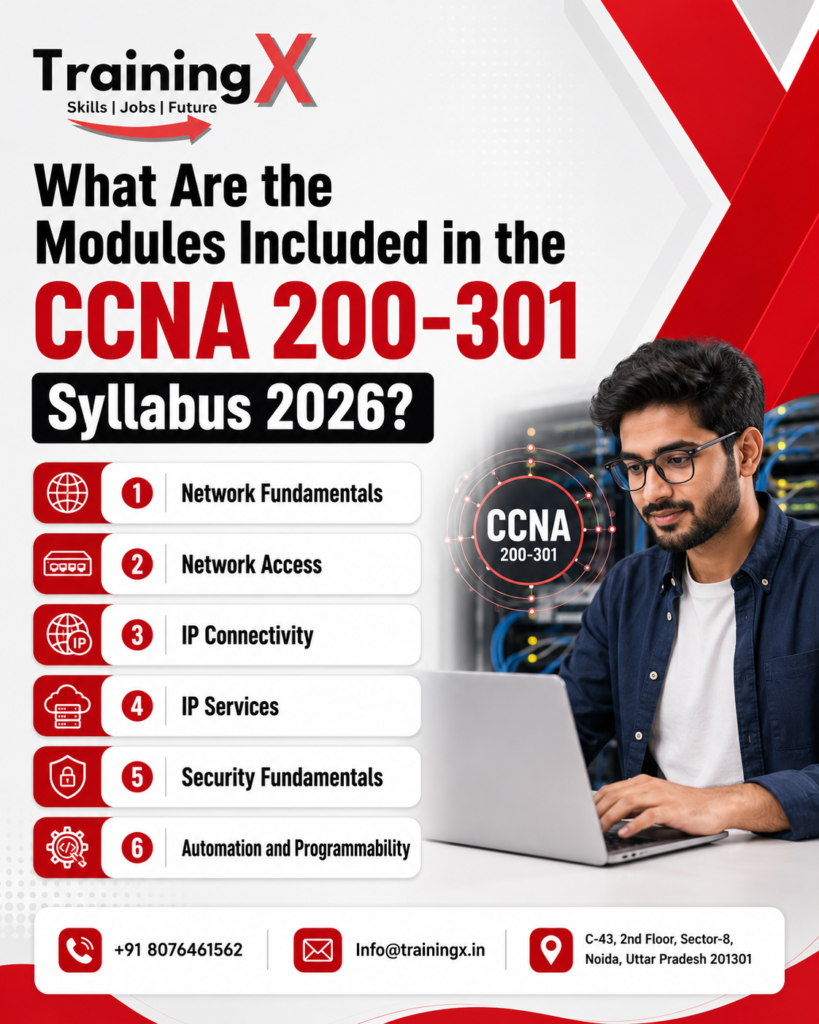
The CCNA 200-301 exam consists of six major domains. Each domain contributes a specific percentage to the overall examination.
1. Network Fundamentals
Network Fundamentals forms the foundation of the CCNA syllabus.
Topics Covered
- OSI and TCP/IP models
- IPv4 and IPv6 addressing
- Ethernet concepts
- Network components and topologies
- Cabling standards
- Wireless fundamentals
Network Fundamentals accounts for approximately 20% of the CCNA 200-301 exam and focuses on networking basics, IP addressing, protocols, topologies, and network device functions.
2. Network Access
This section evaluates your understanding of how devices connect within a network.
Topics Covered
- VLAN configuration
- Trunking
- Spanning Tree Protocol (STP)
- EtherChannel
- Wireless architectures
- Access point management
3. IP Connectivity
IP Connectivity carries the highest exam weightage and is considered one of the most important modules.
Topics Covered
- Static routing
- Dynamic routing
- OSPF configuration
- Route selection
- Routing table analysis
IP Connectivity represents 25% of the CCNA exam and focuses primarily on routing technologies, route selection processes, OSPF operations, and network path determination.
4. IP Services
IP Services focuses on common services used in enterprise networks.
Topics Covered
- DHCP
- DNS
- NTP
- SNMP
- Syslog
- QoS concepts
5. Security Fundamentals
As cybersecurity continues to grow, security knowledge remains a critical component of CCNA.
Topics Covered
- Device hardening
- Access Control Lists (ACLs)
- Security best practices
- Authentication methods
- VPN concepts
- Wireless security
6. Automation and Programmability
Modern networking increasingly relies on automation and software-defined infrastructure.
Topics Covered
- REST APIs
- JSON
- Configuration management
- Controller-based networking
- Software-defined networking (SDN)
Which CCNA Module Should You Focus on the Most?
Students preparing for the exam should prioritize IP Connectivity, Network Fundamentals, and Network Access because these three domains collectively represent 65% of the total exam weightage.
Recommended Study Priority
- IP Connectivity – 25%
- Network Fundamentals – 20%
- Network Access – 20%
- Security Fundamentals – 15%
- IP Services – 10%
- Automation & Programmability – 10%
CCNA 200-301 Exam Weightage Summary
Module Breakdown Table
| Module | Exam Weightage |
| Network Fundamentals | 20% |
| Network Access | 20% |
| IP Connectivity | 25% |
| IP Services | 10% |
| Security Fundamentals | 15% |
| Automation & Programmability | 10% |
Pros of Understanding Weightage Before Preparation
- Helps prioritize high-scoring topics
- Improves study efficiency
- Reduces preparation time
- Increases exam confidence
- Creates a structured learning roadmap
How Long Does It Take to Complete the CCNA Syllabus?
Most candidates require between 8 and 16 weeks to complete the CCNA 200-301 syllabus, depending on prior networking experience. Beginners often spend additional time practicing subnetting, routing protocols, and network troubleshooting through labs and simulation tools.
Practical experience using Cisco Packet Tracer or real networking equipment significantly improves understanding and exam performance.
Frequently Asked Questions (FAQs)
Is CCNA 200-301 difficult for beginners?
CCNA is beginner-friendly, but candidates should expect a moderate learning curve when studying routing, subnetting, and network troubleshooting.
Which module has the highest weightage in CCNA 200-301?
IP Connectivity has the highest weightage at 25%.
How many months are required to prepare for CCNA?
Most learners prepare within 2–4 months with consistent study.
Is subnetting important for CCNA?
Yes, subnetting is one of the most important foundational skills for the exam.
Does CCNA include cybersecurity topics?
Yes, Security Fundamentals contributes 15% of the total exam.
Is automation included in CCNA 2026?
Yes, Automation and Programmability account for 10% of the syllabus.
Can I get a networking job after CCNA?
Many employers consider CCNA a valuable certification for entry-level networking and IT support roles.
Conclusion
The CCNA 200-301 syllabus 2026 covers networking fundamentals, routing, switching, security, and automation skills required in modern IT environments. Candidates who align their preparation with the latest exam weightage can study more efficiently and focus on high-scoring domains. Prioritizing IP Connectivity, Network Fundamentals, and Network Access provides a strong foundation for exam success. Ready to earn your Cisco certification? Follow a structured study plan, practice regularly with labs, and focus on the most heavily weighted topics to maximize your chances of passing the CCNA exam.